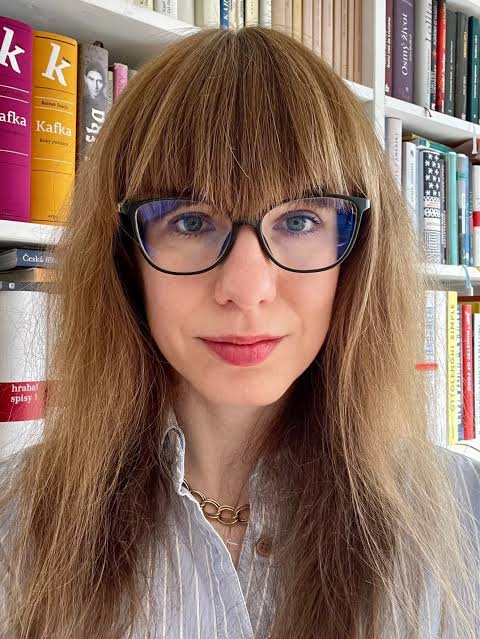
| Marína Urbániková is an Associate Professor at the Department of Media Studies and Journalism at Masaryk University in Brno, Czech Republic. Since April 2026, she has also had an Associate Professorship at Charles University in Prague. Originally from Slovakia, she holds a PhD in Sociology from Masaryk University. Marína serves as Vice-Chair of the Public Media Working Group at the International Association for Media and Communication Research (IAMCR). Working at the intersection of journalism studies and media policy research, she has published work on topics such as PSM regulation, journalistic autonomy or gender in journalism. She co-authored the book Reimagining Public Service Media. Navigating Change and Exploring Public Consensus in the Czech Republic (Routledge, 2025, co-authored with Klára Smejkal, Lenka Waschková Císařová and Iveta Jansová), which was nominated for the Media and Democracy Karol Jakubowicz Award. Marína is also a co-founder of the Czech NGO Women in Media. |
In June, after months of discussion, the Czech government announced its controversial decision to replace the licence fee with direct state budget financing from January 2027. Both Czech Television (ČT) and Czech Radio (ČRo) are often held up as examples of strong public broadcasters that are comparatively well trusted and used by audiences. In this context, how did this decision come about, and in how far does it threaten the independence of Czech PSM?
The decision is primarily political, as there is little evidence that the current funding model requires replacing. Licence fee compliance is high, funding is stable and predictable, and the recently introduced automatic inflation indexation provides an important buffer against political interference. The government has offered no substantive policy justification beyond arguing that licence fees are “outdated,” that many European countries have abandoned them, and that the reform fulfils one of its key electoral promises. Politically, the issue gained prominence after the previous government increased the licence fee for the first time in two decades. The then opposition, now the governing coalition, strongly criticized the increase and made its abolition one of its key campaign promises. Given the absence of a convincing policy rationale, the simultaneous announcement of budget cuts, and the government’s refusal to engage experts and the public in a meaningful debate about the future funding model, the reform appears to be driven by a combination of populist politics and an effort to strengthen political control over PSM. Together with colleagues from three Czech universities, we conducted a comparative study of PSM funding models across Europe, complemented by assessments from international experts. Despite concluding that state budget funding generally poses greater risks to the stability, adequacy, and political independence of PSM than licence fee systems, the government showed little interest in its findings.
The announcement sparked a lot of protest, both domestically and internationally. What is the current situation, and what will the next steps be?
The proposal has triggered sustained domestic and international criticism. Civil society groups organized public demonstrations, media experts voiced strong opposition, and employees of ČT and ČRo held repeated protests, culminating in a one-day warning strike. International organizations, including the European Broadcasting Union, Reporters Without Borders, and the European Federation of Journalists, have also expressed concerns. At the same time, public opinion remains divided. The government has not changed its intention to abolish the licence fee and reduce the budgets of ČT and ČRo. However, the protests helped persuade the government to abandon its original plan of introducing the reform as part of an entirely new and highly problematic PSM law. Instead, it now plans to amend the existing legislation, with parliamentary debate expected this autumn. While the protests are unlikely to change the final outcome, they have undoubtedly increased the political costs of the reform.
In your 2025 book Reimagining Public Service Media, you diagnosed a lack of political and managerial leadership in developing a vision for the future of PSM. Could you elaborate on this, and has it, in your view, contributed to the current situation?
For a long time, both ČT and ČRo largely took their public support for granted. Instead of clearly demonstrating PSM’s distinctive public value, the debate has too often relied on abstract claims that PSM is “a pillar of democracy,” while criticism has frequently been dismissed as politically motivated. At the same time, their leadership did little to articulate a long-term vision or engage the public in a meaningful debate about their future. Combined with limited turnover in senior management, this has encouraged institutional inertia rather than strategic renewal. There has been remarkably little debate, for instance, about how PSM should adapt to the digital age, despite this being a central issue in PSM policy debates elsewhere for years. This has certainly contributed to the current situation, although it is only one of several factors.
The book analyzed Czech PSM from a rather rarely applied multifaceted perspective, researching the expectations of the public, politicians, supervisory board members, as well as PSM managers and journalists. What did you learn from this approach, and were you able to find any common ground between these different stakeholders?
The main lesson was that each stakeholder group evaluates PSM through a different lens. Citizens assess it as users of a broad range of services, valuing not only news but also entertainment, culture, education, and its relevance to their everyday lives. Because citizens primarily perceive PSM through its individual value, PSM organizations need to make a much greater effort to communicate its broader societal contribution. Politicians, by contrast, judge PSM primarily through its news and current affairs coverage. If they perceive its journalism as politically biased, even high-quality non-news content does little to improve their overall assessment. At the same time, we identified an important area of consensus. Across stakeholder groups, there was broad agreement that PSM plays an important role in society, should remain independent of political and commercial interests, and should continue to fulfil its core informational, educational, and cultural roles. The main disagreements concerned governance, funding, and perceptions of the impartiality and fairness of PSM news.
In hindsight, is there any particular discussion or debate around PSM that remains unresolved despite extensive academic research?
There are many unresolved questions. One that particularly concerns me is the segment of the public with negative attitudes toward PSM. Such discontent can stem from very different sources: rejection of the very idea of public service media, dissatisfaction with the performance of a particular PSM organization, the declining personal relevance of PSM in increasingly individualized media repertoires, or opposition to institutional arrangements such as the funding model. We often think of citizens simply as supporters or opponents of PSM, yet the reasons vary considerably and call for different institutional responses. We are currently exploring this issue in greater depth. I also believe we need a better understanding of how public attitudes toward PSM interact with political narratives, as these dynamics are usually studied separately. Finally, despite their importance, we know surprisingly little about how PSM supervisory bodies function in practice. Although their legal design has received considerable attention, there is far less evidence on how different governance models operate across countries.