
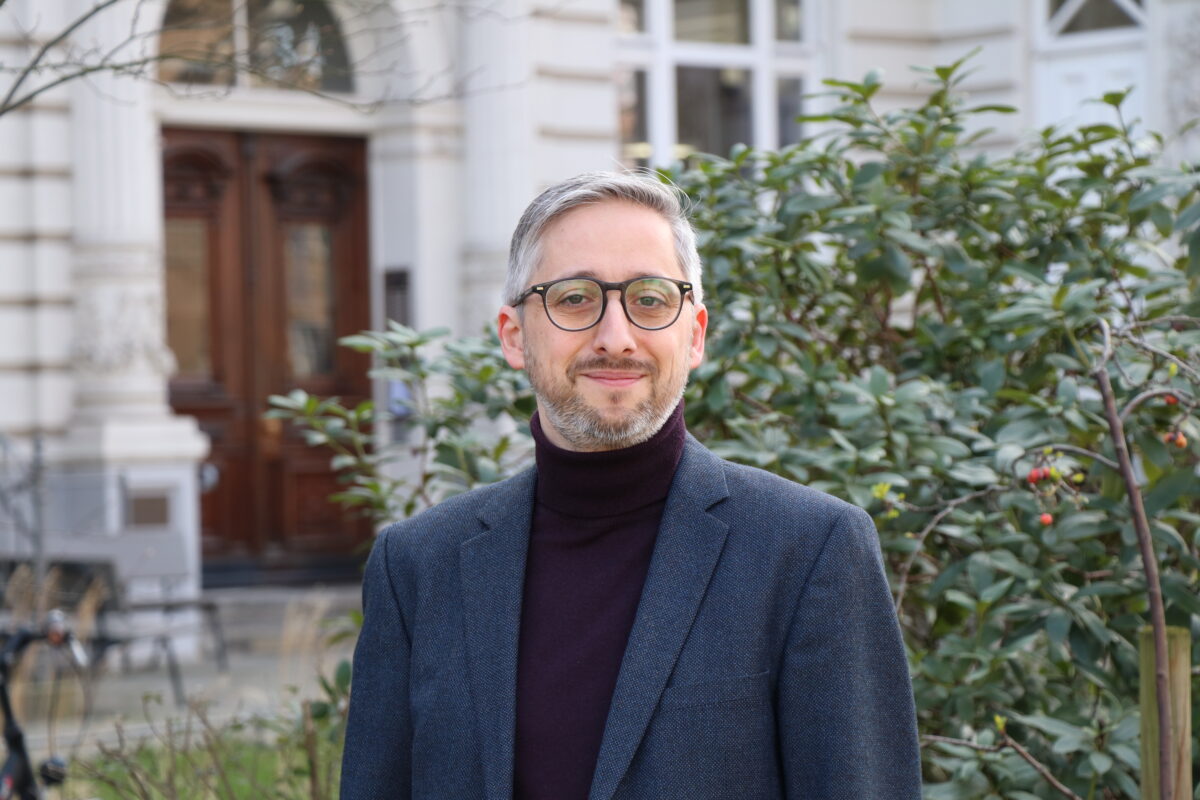
Picture: Christiane Matzen, Leibniz-Institut für Medienforschung
Manuel Puppis is Professor of Media Structures and Governance in the Department of Communication and Media Research at the University of Fribourg, Switzerland. He serves as Vice-President of the Swiss Federal Media Commission (FMEC), an advisory body to the Swiss Federal Government. He holds a PhD in Communication Science from the University of Zurich. Manuel has authored and edited numerous works on topics such as media policy research, media governance and regulation, and has held various roles within the academic community, including Chair and Vice-Chair of ECREA’s Communication Law and Policy Section. In 2024, he received the «C. Edwin Baker Award for the Advancement of Scholarship on Media, Markets and Democracy» from the International Communication Association (ICA).
While earlier opinion polls showed a narrow majority in favour, a clear majority of Swiss voters have rejected the significant reduction in licence fees from CHF 335 to CHF 200 per month and household in the popular vote on 8 March. How did this result come about?
Indeed, in the end 62% of voters – and a majority of voters in every single canton – rejected the initiative that would have cut the SRG’s budget into half and prevented it from using public funds for its online activities. It is typical for popular initiatives that support for them declines as soon as people begin to engage with the issue. It is very rare for an initiative to actually be adopted. While analyses of voting motives have not been published yet, I would assume that most voters understood that the initiative would have led to drastic cuts and would have prevented the SRG from further developing its online offers.
What can (critical) supporters of PSM abroad learn from the Swiss campaign?
I think that the transferability of what happened in Switzerland is somewhat limited due to differences in political systems. Media policy is often the result of negotiations between industry and government, oftentimes taking place behind closed doors. Stakeholder input is mostly limited to public consultations. This is also the “normal” case in Switzerland, but direct-democratic elements of the political system allow for popular initiatives and referenda. In very few instances, this has led to popular votes on media policy issues. This also means that the groups for and against an issue on the ballot need to organize campaigns to convince voters of their position. Communication strategies are very different depending on whether we talk about influencing public consultations or campaigning prior to popular votes. Having said that, one lesson potentially useful is to not assume that the positions of populist parties, libertarian circles, and private media are shared by a majority of the population. But policymakers often do not see this silent majority. It might thus be helpful to activate support networks consisting of cultural and sports associations, academia, and underserved geographical areas, among others, to show the importance of PSM for society.
Notwithstanding the outcome of the vote, the SRG will still have to deal with a significant funding cut. Already prior to the vote, the Federal Council has launched a successive reduction of the licence fee to CHF 300 in 2029. What challenges lie ahead of the SRG in this regard?
Indeed, the government decided to lower the licence fee and to exempt more companies than before from paying the fee. Together with the declining advertising market, this is expected to result in a revenue shortfall of 270m Swiss francs per year – 17% of the SRG’s budget. The SRG has already announced to cut 900 full-time positions in the coming years. The main challenge – as for many media organizations – is to continue offering traditional linear channels while also trying to adapt to digitalization. Hence, the SRG decided that, next to saving money, it needs to restructure the whole organization, which due to Switzerland’s multi-lingual, multi-cultural and federal political systems consists of different units in the different language regions. So far, these units have had a lot of autonomy. This is now partly changing. First, HR, finance and IT departments will be managed jointly. Second, technical elements of production as well as distribution will be consolidated. And third, the genres of fictional entertainment and sports will be centralized as well. The units in the language region remain responsible for information, culture, education and entertainment content, however.
This was already the third plebiscite on PSM funding in Switzerland since 2015. Do you expect the debate about PSM funding to subside to some extent now, also in light of the funding cuts that have been initiated? In other words, what would be needed to shift the focus of the debate on PSM funding to broader questions about the role of PSM in contemporary society?
Switzerland dealt with the future of PSM the wrong way around: Instead of first discussing the SRG’s future remit and then deciding on the necessary budget to fulfil that remit, the whole discussion was about money. In the coming two years, a new SRG licence will be negotiated and then adopted by government. I truly hope that this will allow for bringing in innovative perspectives and discussing what public service should offer to society in the age of AI and platformization so that democracy can still work under digital conditions. Ideas are abound, for instance creating a public open space. However, after the result of the popular vote was communicated, the responsible media minister acted as if SRG had lost, announcing the need to restrict its activities. His motivation? I can only make assumptions, but he was one of the politicians launching the initiative before he became a member of government. And I also do not expect his right-wing Swiss people’s party to cease its attack on PSM. It just works too well in pushing the SRG around.
Together with colleagues from Germany, you have recently analyzed how PSM could build a robust infrastructure for dialogue in the digital sphere. Can you share some insights from this project?
In that project we developed plausible future scenarios of a hybrid public sphere to think about the role media committed to the public interest could play in these potential futures and the options at the hand of media policymakers. Based on that, we argue that PSM could – beyond producing and distributing content – play an important role in organizing dialogue. PSM organizations could monitor communities and their dialogue to identify topics for content production, produce corresponding journalistic content, provide dialogue formats to discuss the topics covered in the journalistic content, and facilitate and moderate this dialogue among citizens. In addition, they could also operate the infrastructure for such dialogue themselves, allowing private media as well as cultural, educational and scientific institutions to use that infrastructure to provide their own content and organize dialogue around it as well. Discussing such visions for the future of PSM – instead of always arguing about its funding – is necessary to generate legitimacy and support for PSM and for its future development.